This report was commissioned from Boke by Turtle Island Innovations to form part of its overall report “Dehcho Clean Energy Plan”, which was created for Big River Services, with funding from Natural Resources Canada (NRCan) through its Clean Energy for Rural and Remote Communities (CERRC) program.
The full report is available here.
Summary
Every Dehcho First Nation member community has more than enough local wood to meet all its energy needs. Replacing even some of the imported diesel with locally harvested wood will create sustainable, local jobs and keep money in Dehcho communities.
Biomass (wood) based heating systems are mature, commercially available technologies. They can operate as standalone systems in individual buildings, or as part of a district energy system that can heat multiple buildings or even an entire community.
Governments have consistently expressed interest in helping indigenous communities transition away from diesel and have funded biomass systems in other communities.
Using pellets in these biomass systems is not recommended.
Pellets make sense if there is a nearby sawmill producing hundreds of tonnes of sawdust every year, and if that sawdust can’t be used for anything else. A more practical, less expensive, and better solution for Dehcho communities is to store harvested wood as logs and then chip them as needed, typically every week or so.
If a community gets to the point where it has replaced most—or even all—the diesel it’s using for heat with locally-sourced wood chips, it can move up to a technology called an Organic Rankine Cycle (ORC) Combined Heat & Power (CHP) system. An ORC converts wood into both heat and electricity.
Like biomass heating systems, ORCs are another mature and readily available technology, with over 2,000 units installed and operating worldwide.
The best local wood to use for fuel is dead standing trees left over after fires.
Forest fires are a big problem in Dehcho. But after the fires are out, the dead standing trees can be a resource, if they’re harvested sustainably. This report gives suggestions on how sustainable harvesting of dead standing trees can work.
The report uses a new dataset—SCANFI, developed through NRCan—overlaid with fire maps—to identify the burn areas near each community most likely to provide the fuel needed. It combines these two data sources to estimate the fuel available from each burn area and the biomass available locally for each Dehcho First Nation member community.
The report includes maps of the areas around each community, pinpointing recommended locations for in-person ground-truthing of the biomass resources available.
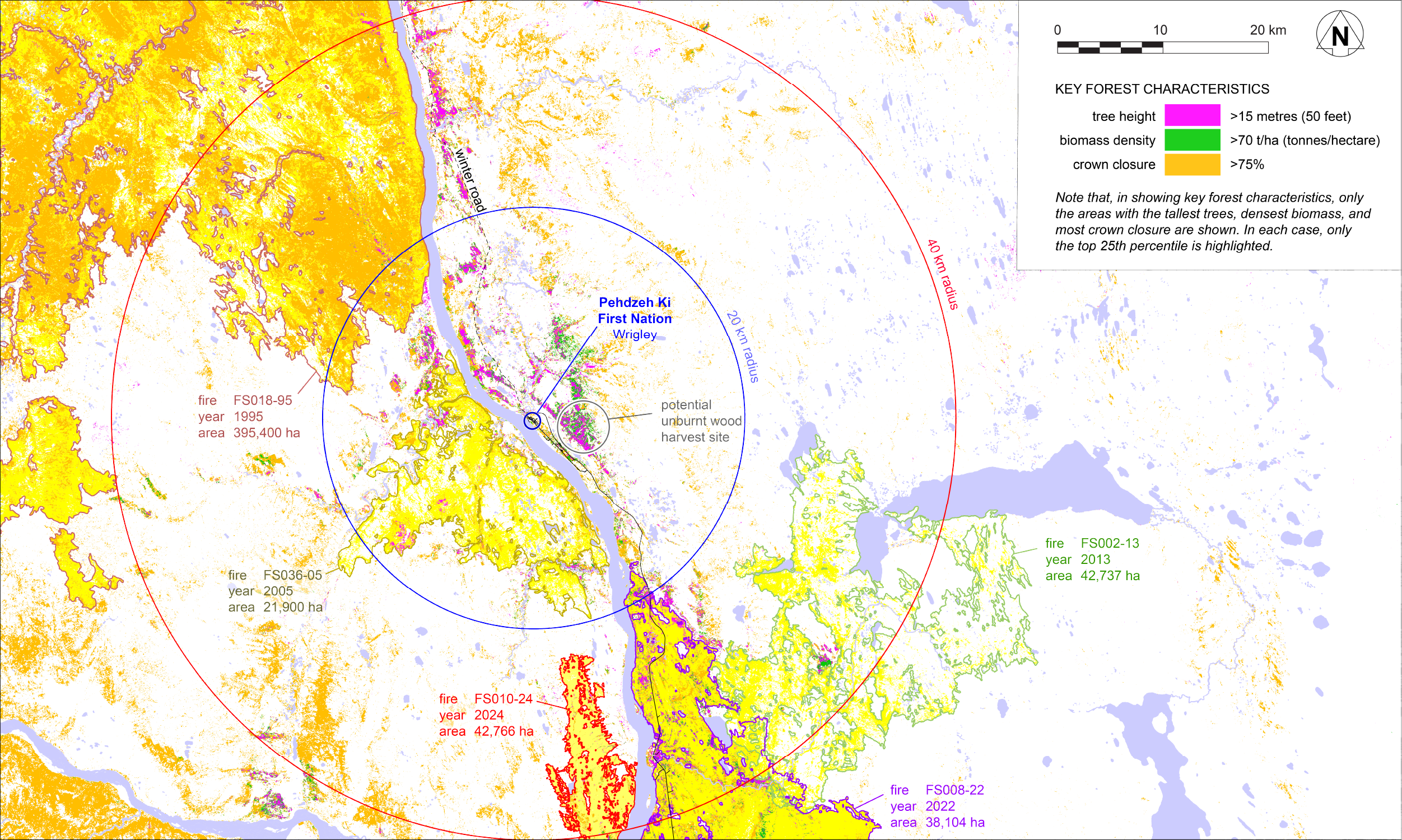 Example of local community biomass resource map – Pehdzeh Ki First Nation (Wrigley)

These maps also suggest locations where unburnt wood could be harvested for other local uses in each community.
Replacing diesel with local wood for heat—and eventually for electricity—requires commitment from the community and from leadership to succeed. It is not a quick fix. But it can be a long-term solution.