
There are hundreds of public works garages in Manitoba—at least one in every municipality; there are thousands throughout Canada.
We were not able to find any example of a public works garage meeting net-zero standards, either in publicly available designs or already constructed. There may be one somewhere but, if so, it is not well publicized.
As currently designed, public works garages consume significant amounts of energy. In Manitoba, their the biggest energy demand is for heat. These buildings have large commercial overhead doors to accommodate the municipality’s large vehicles. When these doors are opened, the heat escapes, particularly in winters in Manitoba.
Properly designed, and with the inclusion of a ground-source heat pump system and a modestly sized solar array, a net-zero public works building is a realistic option. No new or radical design elements are required.
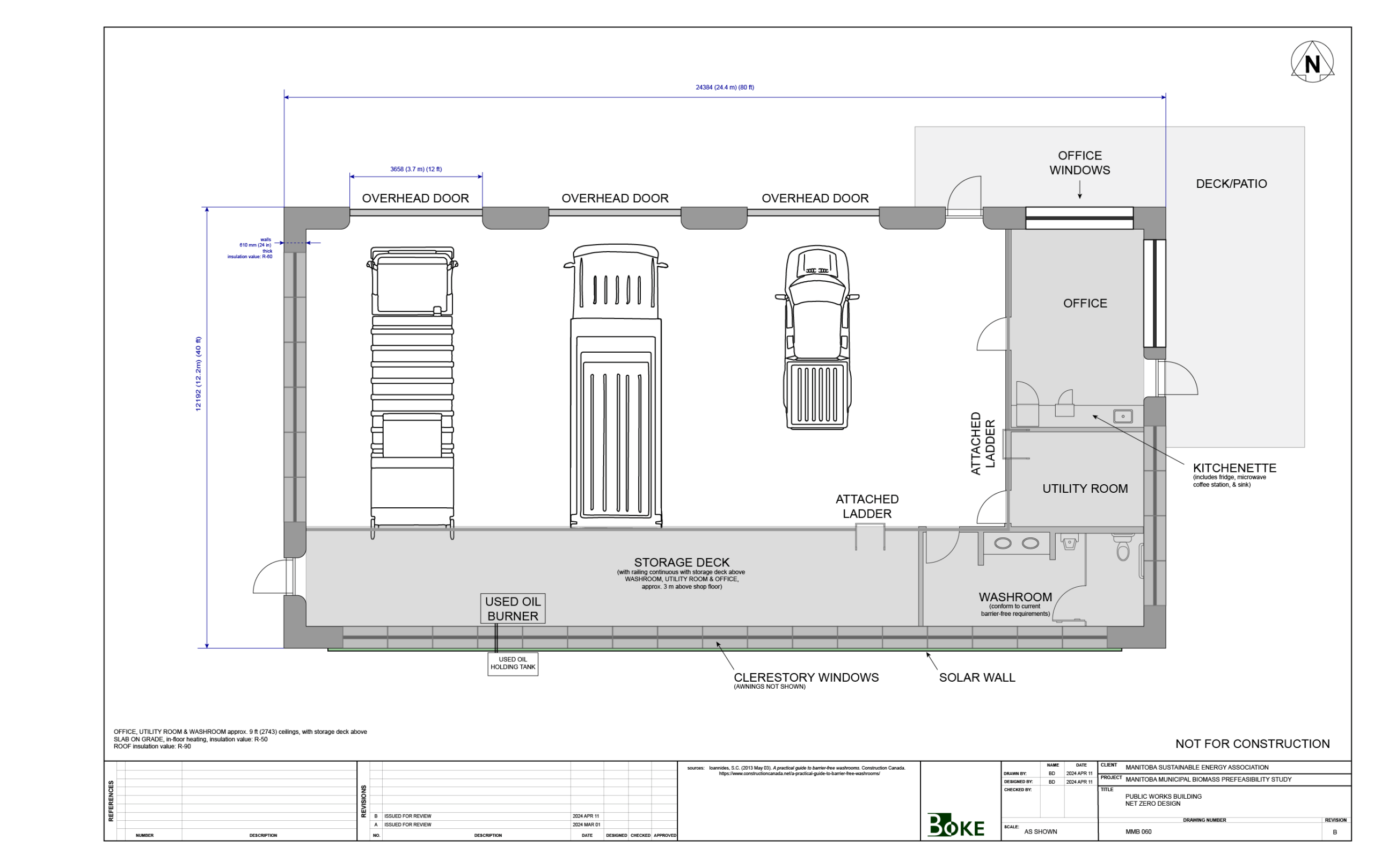
Design Elements
Summary
-
-
- install a district ground-source heat-pump system to provide both heating and cooling for the building
- install a solar array that will produce, in an average year, the same amount of electricity as the building is expected to consume
- include a solar wall as part of the design of the south wall
- build the building envelope to net-zero standards
-
Ground-Source Heat Pump
A ground-source heat pump system (GSHP) will reduce operating costs and provide air conditioning.

Solar Array
A solar array can produce the electricity needed to provide power to the heat pump system and the meet the building’s other energy needs.
Solar Wall
A solar wall should be installed on the south wall, integrated into the make-up air system.
 Because each solar wall is custom designed to its building, it is not possible to know, at the prefeasibility stage, what the energy and cost savings will be from this particular solar wall. Therefore, no estimate of the energy savings for these walls are included in a prefeasibility study.However, this information can be collected by requesting bids from solar wall installers for a specific building. In addition to a firm capital cost, these bids will include estimates of the energy benefits and dollar savings.
Net-Zero Building Standards
There are several specific design elements that should be incorporated into the building that will lower energy costs and—perhaps more importantly—increase employee comfort. These include:
- Orient the building east-west, so that the long wall faces south.
Integrate the ground-source heat pump system with:- in-floor heating
- make-up (HRV) air ventilation
- system
- hot water tank
- wastewater heat recovery
- If the wastewater is from the washroom and kitchenette only, this heat recovery will be minimal. However, if water is also used to wash vehicles and this is collected through a floor drain, the waste heat recovered could be quite significant.
- solar wall on the south-facing wall
- Because of safety requirements and fumes, this building will almost certainly require make-up air ventilation. In winter, depending on the volume of air brought in, heating the cold outside air as it is brought in will be a large energy load. The solar wall will pre-heat the outside air, reducing this heating load.
- Build the exterior walls thicker than building code requires and fill the wall cavity with insulation.
- Ideally, this insulation should be rock wool or slag wool, to maximize fire safety.
- The wall should be constructed to minimize thermal bridging.
- Include high, small (clerestory) windows, with awnings on the south wall, in the design.
- These windows will reduce lighting load without reducing security.
- The awnings reduce direct light in summer, reducing cooling load.
- Incorporate rapid closing, insulated overhead doors in the vehicle bays.
- Include lighting controls that provide supplementary lighting to the light from the clerestory windows, rather than simply on/off lighting.
- The default option for a Public Works Building is to buy a prefabricated steel building. These are simple to order and are produced by several local businesses. However, if embodied fossil-fuel energy is considered, building with wood instead of steel is recommended.

Clerestory Window on Industrial Building
Clerestory windows (like all windows) typically have low R-values. Insulated Glass Units (IGUs) and glass bricks with high R-values are available.
These building design recommendations are only preliminary. The use of a LEED-certified or Passive House building designer is recommended. They will be able to maximize energy savings and minimize total lifetime building costs.
The cost of including a building designer can be at least partially offset through the Federal of Canadian Municipalities’ Green Municipal Fund.